« Software, socially | Main | Deictic systems »
Centripetal/Centrifugal
Miller's description of these two systems as "dwelling places" is particularly appropriate, for in addition to their respective ethotic appeals, expert systems and intelligent agents each instantiate a distinctive spatial tendency. Expert systems centralize and automate expertise, which suggests a centripetal (or inward) movement, while intelligent agents are decentralized and engaged with the environment, a movement that is centrifugal (or outward) (Figures 1 & 2).
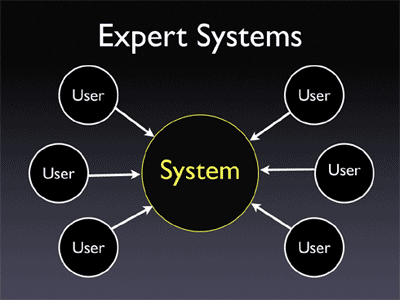 | 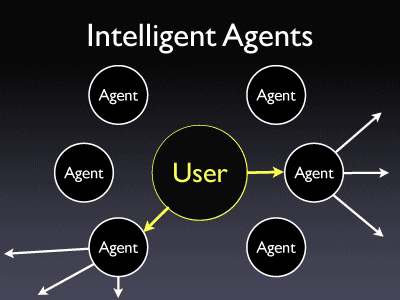 |
| Figure 1 | Figure 2 |
In some ways, these systems are sides of the same coin. Following Daniel Dennett's tongue-in-cheek definition of scholars ("a library's way of making another library"), it's possible to see the users themselves as an expert system's "intelligent agents." As the etymology of centripetal and centrifugal suggests, each of these systems relies on a center-periphery model, with the primary difference between them a matter of where the user (or the computer) is located.
They are sides of the same coin as well in Miller's account, for both represent potentially extreme positions:
In the two cases of expert systems and intelligent agents, and possibly in the larger patterns that Edwards describes, we can see the swinging of a pendulum, from an overemphasis on expertise to an overemphasis on interaction, from a logos-centric to a pathos-centric ethos (212).
It is almost certainly too simplistic (and perhaps optimistic) to imagine that social software might just "split the difference." And yet, I would contend that Miller's characterization of the two models as swings of a pendulum becomes more useful to us if we think of each as having frozen in place its corresponding direction or force. As the pendulum swings from one end to the other, that intermediate space is comprised of models, systems, and/or discourses that mix those forces, that combine both inward and outward movements, depending on what's appropriate.
Academic research provides an obvious example of this. When I work on an essay, it's not entirely unlike the construction of an expert system if we imagine, in the place of "users" along the periphery, different source texts, books and articles that I focus inward towards my own text that attempts to synthesize them (along with my own insights) into expertise that can then be accessed by anyone reading the article. And yet, not all research functions this way. If I follow up on a citation in one of those books, and find yet another text for my essay, that book has functioned as an intelligent agent. If I contact a friend or colleague in an attempt to track down a particular idea or author, again, this is an outward movement. Once the essay is published, it may be used in the construction of other expert systems and/or it may serve as an agent for other writers.
This fluidity returns us to Yancey's evocation of deixis--in the context of research, a given source may function centripetally or centrifugally for us depending on the time and place within the research process where we use it. And I'd guess that the same could be said of most intelligent systems, artificial, natural, academic, or otherwise. But this observation runs the risk of a certain kind of relativism. If the question (which is raised if not asked in Miller's essay) is whether it's possible to conceive of a technological "dwelling place" that doesn't trend towards either extreme, "it depends" seems like a pretty weak answer.

Comments
I should note here that I'm using centripetal and centrifugal in a way that's fairly close to the way that Bakhtin does, and in fact, I toyed with the idea of expanding this section to include Bakhtin.
One key difference, I think, is that B's use of the terms tends to be more global than my own, which I think of as local and situational. Feel free to correct my take on B--I'm no expert--but he uses them placing language (as a shared, social, and ongoing construction) as the center to which they refer. In terms of the "deictic systems" that I talk about in the next section, I'd place more emphasis on the deixis, while B would probably emphasize the system.
That's not meant to be a critique, just an attempt at distinguishing my own (slightly different) inflection of the terms...
cgb
Posted by: collin at June 10, 2005 09:50 PM
My perspective is heavily influenced by recent reading, but I'd say it works okay to leave Bakhtin out. I think of Bakhtin's centripetal/centrifugal is slightly different. In his discussion of semiotic genres, Prior draws on these terms, and in his stuff they seem to fit better with sociogenesis (a term he credits to Vygotsky). Centrifugal/centripetal show up in Ackerman's postscript to B&H's study, too, although they're framed somewhat differently there. And in her discussion of mental models, Geisler develops yet another near match (inward/outward, interiority/exteriority) in the social and cognitive axes. But my semi-informed take on Bakhtin is that he's working at a broader scale relative to language and social activity. I think of his as the sedimentation of sociolinguistic patterns, whereas social software (in a small worlds context) is, as you say, local and situational.
Posted by: Derek at June 12, 2005 07:33 PM