Deixis
In her Chair's Address to the 2004 CCCC, published as "Made Not Only in Words: Composition in a New Key," Kathleen Blake Yancey urges "that we move to a new model of composing" and she locates this model in "three key expressions": the circulation of composition, the canons of rhetoric, and the deicity of technology (311-312). The first two of these expressions are familiar ones; circulation itself has circulated as a key term in our field following the 2001 publication of John Trimbur's "Composition and the Circulation of Writing," and the canons remain one of our rhetorical inheritances from ancient Greece and Rome. The third expression, deicity or deixis, however, is probably not as familiar.
Deixis is also a term that we have inherited from ancient Greece. Aristotle identifies the three types of rhetoric as forensic, deliberative, and epideictic, and it is this latter that has deixis at its root. While epideictic rhetoric represents a "timeless present tense," the transcendence of the moment at which it is delivered, deixis or deicity represents that moment in a more immediate form. As Yancey explains, following Leu et al. ("Toward a Theory of New Literacies Emerging From the Internet and Other Information and Communication Technologies"),
Deixis, linguistically, refers to words like now and then, words whose "meanings change quickly depending on the time or space in which they are uttered" (Leu et al.) or read. The word Now when I wrote this text is one time; as I read the Now in San Antonio was a second time; and now, when this talk is published in CCC and who how many people do (or do not!) read this Chair's Address, it will be many, many other times (318).
Deictic terms address the immediate circumstances of their utterance, and as such, they are both immediate and temporary. And it is this quality of technology that Yancey and Leu et al. seek to capture in invoking deixis. According to Leu et al., "Today, technological change happens so rapidly that the changes to literacy are limited not by technology but rather by our ability to adapt and acquire the new literacies that emerge. Deixis is a defining quality of the new literacies of the Internet and other ICTs."
There is much to recommend in this definition, but there is another element of deixis that is relevant to our considerations of technology. Deictic terms do indeed address a specific time or place, and are thus transitory, but they must also address an audience capable of sharing that reference. And even when the moment has passed, the terms are capable of referencing that moment. As I read Yancey's account of several nows, I have no trouble identifying each one as a moment in a process, each instance summoning a specific scene. There is an immediacy to deixis that functions rhetorically as an invitation to shared experience: we are here, in this place, and now, at this time, and we are connected, however briefly, through the shorthand of deixis. I can only imagine how, where, and when Yancey "wrote this text," but her use of Now invites me to imagine it. However tenuous and transitory, deixis evokes the social.
Software, socially
It's no accident, I would suggest, that the latest wave of technological innovation, the one prompting Yancey's "new model", is also preoccupied with the social. In the past few years, the phrase "social software" has emerged, transformed by its adherents from a small subcategory of software (designed to assist users with the planning of social events) into what may turn out to be a new paradigm or era in the history of software development.
As Christopher Allen's history of social software reveals, sociality is hardly a new element in our use of technology. What has changed, however, is the centrality that social considerations now possess when it comes to the design of technologies. From a certain perspective, this change is a negligible one. Take email, for example. Without putting too fine a point on it, email accomplishes a simple function--it provides a nearly frictionless way to transport data from one person or place to another. This simplicity is one of the great strengths of email, and also one of its weaknesses (one that spammers have exploited relentlessly in recent years). With less information than you would need to put on an envelope, you can send an email to anyone with an address.
And as a result of this simplicity, email is put to a variety of social uses, from sharing information in the workplace to keeping in touch with friends, and much more besides. And yet, none of these uses are intrinsic, nor even really necessary, to the primary function of email, the transfer of data from one machine to another barring a direct connection between them. This function implies equally simple criteria with which we gauge the effectiveness of email--if it transfers this data accurately and quickly, it has served its purpose.
The development of social software, however, emerges into a much more complicated conceptual space. In "Expertise and Agency: Transformations of Ethos in Human-Computer Interaction," Carolyn Miller draws on the work of historian Paul Edwards as a means of locating ethos in our interactions with technology. Edwards delineates two "related discourses" that emerge in HCI during the cold war: closed-world discourse and cyborg discourse. She explains:
In this essay, I will explore these two modes as the rhetoric of machine control and the rhetoric of computational subjectivity, using the specific examples of expert systems and intelligent agents, two technologies in which the role of ethos is foregrounded. Both expert systems as intelligent agents blur the boundaries between human and machine, creating "hybrids" (in Latour's term) or "cyborgs" (in Haraway's). Such human-computer hybrids transfer to the computer some aspects of human character and require some adaptation by a human interactant, creating a "system," or dwelling place, where both must abide (199).
Expert systems are relatively self-explanatory; they are computer systems designed to operate at the level of a human expert. According to Miller, they
- depend on a database of specific knowledge,
- are designed to "learn,"
- provide accounts of their reasoning, and
- provide reasonable responses even when knowledge is uncertain or incomplete (199-200).
Amazon provides a perfect contemporary example of an expert system, in that it contains not only a vast database of bibliographic information, but an extrapolatory search function and because it tracks searches and purchases, the site learns in a way that provides expert information on books. This is not all that the site accomplishes, but at its core, Amazon provides users with a kind and breadth of expertise about books that even a human expert would be hard-pressed to duplicate. And this expertise is where the ethos of this system is located; in a more strictly organizational context, an expert system allows relatively minor informational tasks to be automated, freeing employees to devote more time to tasks requiring human interaction, judgment, etc.
Unlike expert systems, which centralize the knowledge of an organization into databases, an intelligent agent (usually a piece of software)
- interacts with its environment,
- must be able to perceive and initiate action in the environment, and
- is autonomous, "to some degree." (208)
Rather than mimicking (or even exceeding) the capacities of an expert, agents simulate a more casual form of information-gathering. For example, I may ask a friend for a book recommendation, a query based not (necessarily) on that friend's expertise, but on my experience that she and I have similar tastes. Depending on how closely our tastes coincide, I may consider particular movie reviewers (and indeed, they hope that I consider them) as agents.
Technologically, there are a number of intelligent agents devoted to searching. For example, Google allows you to initiate ongoing searches (Google alerts) that applies the search terms you set to pages as they are posted or published on the web, and sends you results via email. Although these queries don't offer much more functionality than the search engine itself, it is certainly possible to imagine that, were they to become more sophisticated, they might track which results tend to attract a user's attention and/or track other keywords that show up with some frequency. For instance, if I set a query to email me articles about "social networks" and Duncan Watts's work shows up in a number of my results, this more advanced agent might include Watts as an additional category of interest for me.
Rather than expertise, then, intelligent agents carry ethos insofar as they are worthy of our trust, an ethos that is much more aligned with pathos, according to Miller, and that can be distinguished from the logos offered by expert systems. They work partly because of the relationships that users develop with them.
Centripetal/Centrifugal
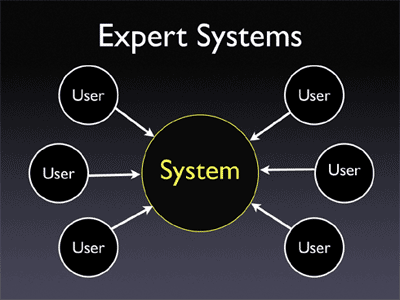
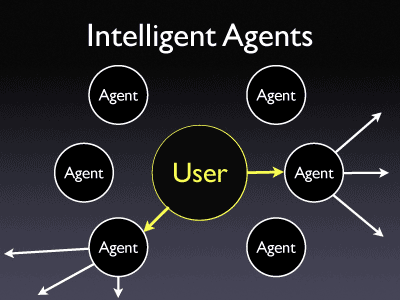
Miller's description of these two systems as "dwelling places" is particularly appropriate, for in addition to their respective ethotic appeals, expert systems and intelligent agents each instantiate a distinctive spatial tendency. Expert systems centralize and automate expertise, which suggests a centripetal (or inward) movement, while intelligent agents are decentralized and engaged with the environment, a movement that is centrifugal (or outward) (Figures 1 & 2).
 |
 |
| Figure 1 | Figure 2 |
In some ways, these systems are sides of the same coin. Following Daniel Dennett's tongue-in-cheek definition of scholars ("a library's way of making another library"), it's possible to see the users themselves as an expert system's "intelligent agents." As the etymology of centripetal and centrifugal suggests, each of these systems relies on a center-periphery model, with the primary difference between them a matter of where the user (or the computer) is located.
They are sides of the same coin as well in Miller's account, for both represent potentially extreme positions:
In the two cases of expert systems and intelligent agents, and possibly in the larger patterns that Edwards describes, we can see the swinging of a pendulum, from an overemphasis on expertise to an overemphasis on interaction, from a logos-centric to a pathos-centric ethos (212).
It is almost certainly too simplistic (and perhaps optimistic) to imagine that social software might just "split the difference." And yet, I would contend that Miller's characterization of the two models as swings of a pendulum becomes more useful to us if we think of each as having frozen in place its corresponding direction or force. As the pendulum swings from one end to the other, that intermediate space is comprised of models, systems, and/or discourses that mix those forces, that combine both inward and outward movements, depending on what's appropriate.
Academic research provides an obvious example of this. When I work on an essay, it's not entirely unlike the construction of an expert system if we imagine, in the place of "users" along the periphery, different source texts, books and articles that I focus inward towards my own text that attempts to synthesize them (along with my own insights) into expertise that can then be accessed by anyone reading the article. And yet, not all research functions this way. If I follow up on a citation in one of those books, and find yet another text for my essay, that book has functioned as an intelligent agent. If I contact a friend or colleague in an attempt to track down a particular idea or author, again, this is an outward movement. Once the essay is published, it may be used in the construction of other expert systems and/or it may serve as an agent for other writers.
This fluidity returns us to Yancey's evocation of deixis--in the context of research, a given source may function centripetally or centrifugally for us depending on the time and place within the research process where we use it. And I'd guess that the same could be said of most intelligent systems, artificial, natural, academic, or otherwise. But this observation runs the risk of a certain kind of relativism. If the question (which is raised if not asked in Miller's essay) is whether it's possible to conceive of a technological "dwelling place" that doesn't trend towards either extreme, "it depends" seems like a pretty weak answer.

Deictic systems
One possible approach, one that proves less relativistic, is to reframe the question. Specifically, is it possible to conceive of a technological "dwelling place" that accounts sufficiently for the deictic nature of technology? If Leu et al. are correct, and the pace of technological change is accelerating, then it stands to reason that deixis is an increasingly urgent concern for the design of technological systems.
I would argue that this is part of the reason behind the upsurge in social software, for social networks provide us with an obvious analog for what we might term, paradoxically, "deictic systems." Our social networks are not necessarily technological, although certainly technologies play various roles in their constitution. More to the point, though, they are in constant flux, partly through our own activity (as we make efforts to meet new people and maintain contacts and relationships with the people we know) and partly also through serendipity (chance meetings, friend-of-a-friend introductions, etc.). A social network is sufficiently deictic, in fact, that it would be difficult to map even a single person's network fully before that network changed, albeit subtly.
While it's perhaps unremarkable to speak of social networks (or "networking") in a colloquial sense, it's worth asking whether or not there's a (potentially unbridgeable) gap between the colloquial, phatic "network" and the kinds of systems that Miller writes about. To put it more simply, do we each really possess social networks? Am I justified in seeing the collective group of my friends, nemeses, and acquaintances as a network per se, as opposed to an aggregate of the people who know me, some intentionally, some coincidentally, and some for a longer time than others?
The emerging field of network studies would answer this question affirmatively. Defining networks in the loosest possible terms (Duncan Watts, for instance, describes networks as "collection[s] of objects joined together in some fashion"), the scholars in this field span a range of disciplines, where they are slowly accumulating a series of network properties and behaviors that persist across dissimilar phenomena. Works like Watts' Six Degrees and Malcolm Gladwell's The Tipping Point, as well as any number of other network scholars, assert that there are indeed generalizable features to our social networks.
Watts, in particular, devotes considerable space in Six Degrees to the definition and explication of "small-world networks," so named for their ability to explain the small-world hypothesis:
The hypothesis was that the world, viewed as an enormous network of social acquaintances, was in a certain sense "small"; that is, any one person in the world could be reached through a network of friends in only a few steps. It was called the small-world problem, after the cocktail party banter in which two strangers discover that they have a mutual acquaintance and remind each other what a "small world" it is (38).
As Watts observes, it would be foolish to view our social networks as aggregates of individuals; "[W]e don't just have friends," he explains, "rather we have groups of friends...Within each group there will tend to be a high density of interpersonal ties, but ties between different groups will typically be sparse" (71). As Watts and his various colleagues began to try and model these networks, they identify two variables:
On the one hand, the network should display a large clustering coefficient, meaning that on average a person's friends are far more likely to know each other than two people chosen at random. On the other hand, it should be possible to connect two people chosen at random via a chain of only a few intermediaries. Hence, even globally separated individuals will be joined by short chains, or paths in the network (77-78).
On the face of things, these two variables would seem to be inversely related. The denser your cluster of relationships, the less time you would have to forge ties with other groups or clusters. And yet, Watts and Steve Strogatz discovered that these variables actually change at different rates, which means that there is indeed a class of networks where both the rate of clustering and the rate of connectivity are increasing: small-world networks.

Small-world networks
There is a sense in which small-world networks are trivial, for we inhabit them on a daily basis by virtue of our social networks. Disciplines of study are small-world networks, for example: they are highly clustered into graduate programs and academic departments, dense clusters of faculty and students. And yet, each person in a given program comes there from another program, either from graduate school or a position at another school.
All of my friends from graduate school are connected, whether they know it or not, to the members of Syracuse's Writing Program. And vice versa. And each of those friends holds a position in another program, the collected members of which are connected to me through my friends. In a matter of three degrees (each connection between two people is a degree), the graduate students at Syracuse, for instance, are connected to the faculty and graduate students at Purdue University, the University of Texas, Penn State University, and so on. Each of the SU students knows someone (me) who knows someone (my friend) who knows the people at those institutions and many more besides. And I am only one of eleven faculty in the program at SU, from a relatively small graduate program. Multiply the extent of my own network by the number of faculty at each institution, and it's difficult to imagine that there is anyone in our field who couldn't be connected to anyone else in much more than 3 or 4 steps.
Observations like these become much less trivial or obvious when we reflect upon the ways that clustering and connectivity occur in both the structure and the dynamics of our programs (to borrow terms from Watts once more). Structurally, for example, a core curriculum serves to reinforce the density of the cluster. Students who attend the same class can be assured of a relatively common and shared experience, but a core curriculum is supposed to ensure that students in different cohorts, taking a course in different incarnations, also share that experience. Elective courses, on the other hand, are likely to change more frequently, and more radically, with the passage of time, serving to connect the intellectual work of the program with a broader range of topics and areas within a discipline. Program dynamics include not only tenure (which both rewards and insures a continuity in a program's faculty) but also the custom against hiring one's own graduates (every faculty hire forges a new tie between a program and the new hire's socio-disciplinary network).
Watts, then, provides us with a vocabulary for framing our social networks, but what does this accomplish? In terms of the questions that I've tried to set forth here, this suggests that small-world networks, like the one that we refer to as our discipline, function as deictic systems. Our programs and departments change regularly, with every decision about curriculum and hiring, with each new person who joins the local network and each member who leaves. And yet, they remain stable as well, persisting to a greater or lesser degree despite (and sometimes, because of) those changes.
I would argue that Watts' discussion of clustering and connectivity correspond roughly to my earlier discussion of centripetal and centrifugal forces, respectively. And if this is indeed the case, then the idea of small-world networks has important implications for Miller's pendulum, or rather my attempt to extend her metaphor beyond the scope of her essay. Small-world networks cannot exist along the swing of that pendulum, for according to Watts, they represent systems that move, for a brief time, both towards centripetality and centrifugality. This seeming paradox has important implications for our understanding of social software, particularly if (and as) we adapt it for pedagogical purposes, the focus for the remainder of this essay.

Classrooms, networks, systems
At a general level, Miller's discussion of expert systems and intelligent agents might encourage us to think about the relationship between technology and our writing classrooms. Most classrooms, both within and outside of our discipline, function as expert systems, and this (in our discipline) despite a push towards social and/or student-centered pedagogies. Distributing authority and responsibility for the classroom among its various members does not substantially alter the centripetal force that underscores the classroom; in the student-centered classroom, the instructor may not represent herself as the "expert" at the heart of the system, but there is considerable institutional inertia that holds her there.
To be fair, as teachers, we don't experience our classrooms this way. A given course, from our perspective, is one node among the various courses that each of us has taught in his or her career. It is one node in a vast network of courses offered each semester on our respective campuses, themselves nodes in a network of higher education that spans the nation and even the globe. Intellectually, the practices in our courses are drawn from a disciplinary network of knowledge, and they are embodied in documents that themselves circulate throughout departments and disciplines as well. From our perspective, then, the classroom is a highly porous space, shaped by networks and forces of every sort.
But for our students, particularly those in first-year writing classrooms, exposure to these various networks is limited, as is our own exposure to the networks that our students participate in. And so to accomplish the various goals we set for our courses--the demands of the institution, the curricula of our programs, and the educational needs of our students--we imbue our classrooms with that centripetal force. We subject our students to a certain, necessary degree of standardization--shared texts, assignments, activities, evaluation criteria, etc. There is certainly more to the classroom than its status as an expert system, but the ethos of centralization and expertise underwrites this space.
The classroom is a social space as well. Even the most univocal, lecture-oriented classroom brings students together and unites them through the shared reception of lectures. In the writing classroom, students must be able to work together, to respond to each others' writing, and to hold discussions both about their own work and course readings. In short, much of the work of the writing classroom depends upon a certain amount of social cohesion, of clustering, to use Watts' term. In a first-year writing classroom in particular, most of the students are likely to begin a course as strangers to each other.
It's no accident, given this context, that one of the primary uses to which technology is put in such classrooms is the buliding of community. Chat spaces, MUDs and MOOs, bulletin boards, listserves--there are any number of applications that predate the development of "social software" which themselves can serve social functions. In part, this is why social software would be so appealing to writing teachers. Steven Krause's essay "When Blogging Goes Bad: A Cautionary Tale About Blogs, Email Lists, Discussion, and Interaction" is partly his account of the appeal of weblogs, and his eventual disappointment with them, concluding:
...many writing teachers seem to be using blog spaces as places to facilitate dynamic and interactive writing experiences....But after a failed experiment in teaching with blogs, I have begun to wonder if it is advisable or even possible to see blogs as a collaborative or especially "interactive" writing environment. Or, more accurately, I've come to believe we shouldn't substitute blogs for other electronic writing tools that foster discussion and interactive writing, particularly email lists, commonly known as "listservs."
The assumption that lurks behind this claim is one that we don't often question in pedagogical reflections. Specifically, it is the notion that "dynamic," "interactive," and even "collaborative" writing, to be recognized as such, must occur within the conceptual space of the classroom. And furthermore, that such goals are the result of a certain level of community that has emerged there. Clancy Ratliff puts it more explicitly in a handout for her students, posted at her own weblog:
Weblogs allow a high level of interactivity; in your posts, you’ll be able to link to other web sites, other blogs, or other news stories. If you want to respond to your classmates’ posts, you can do that easily as well. Sharing your writing with others in the class and reading what your classmates write is also an excellent way to build community and get to know each other better.
There is nothing "wrong" with either of these passages, but each envisions a particular pedagogical role for weblogs, one that is largely centripetal. Weblogs may sit on the periphery of the physical classroom--I'm assuming in both cases that very little non-introductory class time was spent on the blogs themselves--but their function is to face "inward," even as the weekly assignments are completed "outside" of the class. And that function is grounded in a particular need, the need for a certain amount of cohesion.
And insofar as that is a central pedagogical problem, weblogs may not provide the best solution. But where Krause writes that
we shouldn't substitute blogs for other electronic writing tools that foster discussion and interactive writing
I would say instead that
we shouldn't expect from blogs the same kinds of discussion and interactive writing we associate with other electronic writing tools
This is a small change, perhaps, but a crucial one, I think. This observation, that weblogs are not as effective as listservs at doing what listservs do, leads productively to the question of what blogs qua blogs can accomplish for us in our classrooms.
Weblogs as small worlds
Ultimately, I want to argue that weblogs encourage the creation of the kind of small-world networks that I am discussing here, that they allow us to engage in both centripetal and centrifugal gestures, thereby enabling both the structure and dynamics of such networks. As a way of making this series of claims more concrete, I turn in this section specifically to the blogroll.
The blogroll is one of the core features of the weblog, one that hearkens back to the earliest stages of weblogs in their incarnation as filter or link logs. At its simplest, the blogroll is simply a list of those people and/or sites that a given blogger chooses to acknowledge. There are any number of possible motives for inclusion: reciprocity, admiration, identification, etc. It may serve a practical purpose as well; it is often easier for me to use my blogroll as a set of bookmarks to take me to a particular site.
As a system, the blogroll bears a synecdochic relationship to weblogs in general, and as such, provides a perfect example of the larger claim with which I want to end this essay. My own blogroll contains a broad cross-section of people and motives: in this list, I include people I consider close friends, my faculty and student colleagues here at Syracuse, colleagues who were once students at SU, friends of friends, acquaintances (academic and otherwise), and even people with whom I have little to no connection whatsoever, but whose writing I value. In many cases, the only thing that some of these people have in common with others of them is that they're all on my blogroll. Many of these links are centripetal in that they reinforce friendships that pre-date my blogroll, but there are plenty that are centrifugal as well. And the status of any given link can change over time--I may lose touch with someone I once saw almost every day and someone I knew only through my computer screen may become a colleague. The link may stay the same, but my investment in each of those links fluctuates.
In other words, the blogroll, even one as static as mine tends to be, functions as a deictic system, a space with a certain amount of stability and centripetal force which nonetheless makes room for centrifugal gestures as well. And just as I check my friends' blogrolls to see if there are new sites that I might want to add to my own, I assume that at least some of them do the same for me. Blogrolls strengthen the ties among those in a particular neighborhood of weblogs, but they also serve as intelligent agents, tipping me off to other resources or sites that I'll investigate because I trust the person doing the linking.
Are these kinds of activities social? Collaborative? Interactive? Dynamic? Of course they are. Will they show up in a way that allows them to become part of the economy of the writing classroom? That's a trickier question. Blogrolls, and blogs more generally, provide a relatively stable space for variation, a deictic system for writing, that only partly overlaps with the expectations typically found in the writing classroom. Blogs allow for a proliferation of discursive gestures, both centripetal and centrifugal, both inward and outward, but these various gestures aren't all equally valued in pedagogical contexts.
Conclusions
To maintain a blog, I would argue, is to participate in a small-world network, one that involves both clustering and connecting. The combination of these forces (embodied in any number of different kinds of gestures) results in a different kind of writing altogether.
This is part of what I take Will Richardson to be saying when he writes:
I'm not journaling. I'm not just linking. I'm attempting to synthesize a lot of disparate ideas from a varitey of sources into a few coherent sentences that I can publish for an audience and wait (hope?) for its response to push my thinking further. That's the essence of blogging to me, and I can't do it without a Weblog. That's the distinction. That's what tells me this is different. And that's what makes me think so hard about the effects that blogging, not just using a blog, might have in a classroom.
One of Richardson's persistent themes at Weblogg-ed is not how we can change blogging to accomodate our classrooms, but rather whether and how we need to change how we think about schooling in order to tap into the energy that so many people are bringing to weblogs. This tension, between the necessary gravitational pull of the classroom and the outward-looking, exploratory possibilities that weblogs (and other social software applications) make possible, is one that will most likely remain with us for some time. Part expert system, part intelligent agent, weblogs necessarily "dwell" on the borders between our classrooms and the world where they are situated, and using them pedagogically opens up numerous risks and rewards, consequences that we are only just beginning to account for.
Perhaps it is overly optimistic of me to think so, but I believe (as Richardson does) that, rather than testing weblogs to see if they "work" in the context of our writing classrooms, we should be thinking about those classrooms and about whether or not they provide the kinds of spaces that allow for the full possibilities of blogging. At the very least, weblogs are beginning to make visible some of the constraints of an educational system grounded in print technologies.