| • | |
our manifesto
In our dreams chat bubbles fill the computer screen. We train our eyes on them, one at a time, as they fade under our gaze, only to reappear when we look away. Frantically our eyes dart from one message to the next, words sinking and resurfacing, as we struggle to make meaning, to connect with the words of others across the midnight sky.
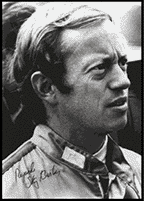
Our own fantasies about speed lead us to dream of a few laps around the track at one of the Skip Barber Racing Schools, where, through “a structured curriculum of classroom and track sessions,” we could release our inner Andretti.
But freewriting can only pretend to be quick in an age of fast technology. Value in the feel of it, the scratchy slow achy cramping hand. At the 2004 Bard Workshop on Writing and Thinking in the small group session, everyone frantically scribbling on legal pads-yellow, white, purple-Elbow says:
“There is something about the [Feel of? Sound of? Smell of? You fill in the blank ______] pen on paper.”
Yeah. You’re right. There is something about it. It’s slow.
somebody else's
We affirm that the world’s magnificence has been enriched by a new beauty: the beauty of speed. A racing car whose hood is adorned with great pipes, like serpents of explosive breath—a roaring car that seems to ride on grapeshot is more beautiful than the Victory of Samothrace.
“Freewriting is what you get when you remove all the normal constraints involved in writing,” say the editors of a book investigating freewriting. You don’t need to stick to one topic, or feel compelled to write with any kind of “excellence or caring.” The writing can be utter “garbage.” The only requirement is that you put words down one after the other and don't stop for anything until the time is up.
Freewriting is not without constraints, according to Elbow. Freewriting has, in fact, one important constraint: You must keep writing. You cannot stop.
But freewriting has another important constraint, it seems to us, one that Elbow completely ignores: the constraint of the page. Remove that one and what do we have? You must keep writing. You cannot stop.
“The entire experience is, and always has been, dominated by an overbearing feeling of coercion.”
In the tension between speed and control, we find the thrill of performance. Except in struggle, there is no more beauty.
dialogues and exchanges
Go: What are all the names for freewriting?
Stop: Focused freewriting, inkshedding (I like that one but what is it really), and free freewriting--no topic told to you.
Go: So, what is not freewriting?
Stop: Maybe anything that is not good is freewriting? And what does that say about what we expect of our students?
Go: Yeah. Can freewriting really represent what and how students write and fit with what they want to do with writing?
Stop: And how many people does freewriting leave out?