| • | |
our manifesto
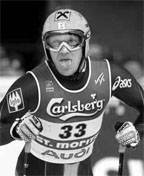
The January 26, 2004 issue of The New Yorker housed an article by Burkhard Bilger entitled, “The Sporting Scene: Twin Peaks,” with the tag line “Herman Maier came back after a near-fatal crash; Bode Miller was waiting.” Maier is the quintessential Austrian skiing machine, powerfully built, meticulously conditioned, stylistically precise and methodical. He was in fact “in the best shape of his career” when he crashed his motorcycle into an oncoming vehicle, shattering the “physically perfect” athlete (as he later characterized himself) into a dozen pieces. He applied a familiar persistence to his recovery (Don't. Stop. Don't…Stop. dontstopdontstopdontstopdontstop), and he retook a world cup race a mere two years after the accident that nearly took his life.
The article pits Maier against a young upstart, a renegade, a rebel, a racer who comes to the World Cup “from out of nowhere—that is, from the United States.” The rest of the article paints the American kid, Bode Miller, as an improbable success story. The Lance Armstrong of the Super-G. An athlete who “irritat[ed] coaches. . .[with his] long, flailing limbs and high center of gravity.”
“His technique,” according to Bilger, “was even gawkier than his physique”:
“[H]e liked to take turns impossibly late, leaning back like a water skier, and he often failed to plant his poles. ‘There were times when I saw him crash every single race for six weeks,’ Chip Cochrane, his [high school] coach says…On the slopes, he was sometimes a laughingstock… [T]here were moments when you could see that he was going as fast as anyone could possibly go. He just never managed to run a whole race at that speed.”
Miller skis all-out, as Elbow advises us to write. Bilger describes him at one point as having “an acrobat’s ability to skirt the edge of disaster.” Other descriptions were more colorful: “[H]e was like a cat being thrown from an icy driveway: his body was every which was in the air, but he’d still land on his feet.” Maier, for his part, has become self-conscious since the accident. He worries, for example, whether his leg will hold up on the hard turns. And he recognizes that this attention to his potential shortcomings proves a major obstacle to his return to true racing form. “I will be happy,” Maier says, “when I get rid of this thinking again.”
somebody else's
We stand on the last promontory of the centuries! Why should we look back, when what we want is to break down the mysterious doors of the Impossible? Time and Space died yesterday. We already live in the absolute, because we have created eternal, omnipresent speed.
dialogues and exchanges
She: Say more about the tension between speed and control. Can you link what you did at Skip Barber to what we've talked about with music?
He: Driving and music have similar things to say about control and speed/the idea being that speed is more of a practice tool to develop skill than it would be a part of the actual event, driving or playing an instrument
A fundamental point is to completely trust the feel of the car and pay no attention to the meters. They basically do not let you (strongly discourage you) from even look at them [. . .] they make you really listen to/feel the engine to determine things
She: So can you relate it to skiing
He: There are similarities in the sense of edges and breaking a bit/my instructor always said things like "the tires aren't working unless there screeching". . .and the same thing with edges on skis-you need to be on them hard, really hear them cutting in
She :And you have to pay attention to conditions and make adjustments in the moment, etc.
He: Yeah that is true-and the whole goal of practice, like with most things, is the old jazz quote-learn everything, then forget it all and just play applies to both skiing and driving I think